A student once asked me, “Sir, if I already have UPI, why do I need a digital rupee?” It is a good question, and it is exactly the kind of thinking RBI wants in an interview. Let us understand the e₹ from the ground up.
What is a CBDC?
A Central Bank Digital Currency (CBDC) is money issued by the central bank in digital form. In India it is called the Digital Rupee (e₹).
- It is legal tender, just like a ₹100 note.
- It is a direct liability of RBI (your bank balance is a liability of your bank, not RBI).
- It earns no interest.
Types of CBDC
| Basis | Type | Meaning |
|---|---|---|
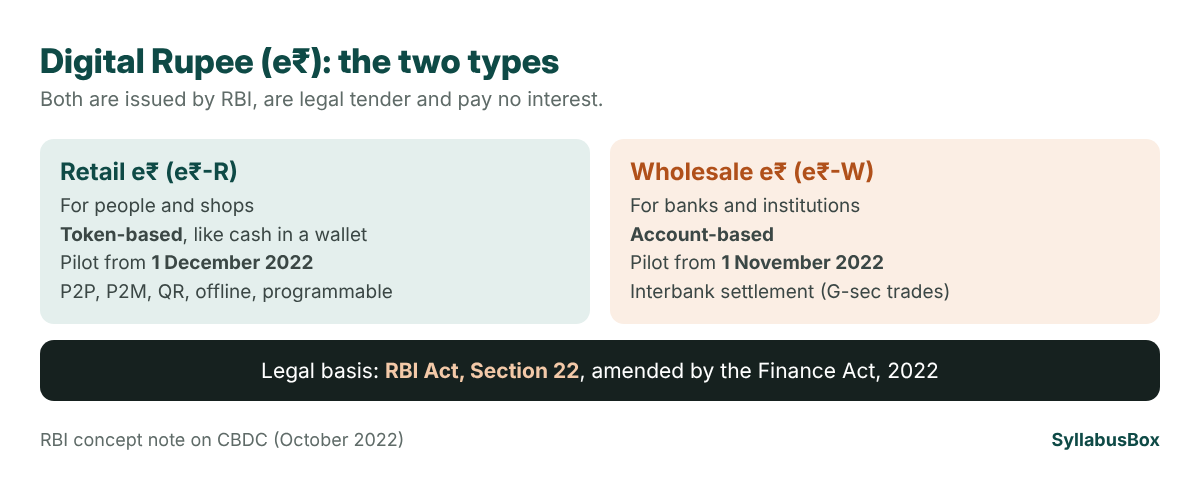
| Users | Retail (e₹-R) | For everyone: people and businesses, for daily payments |
| Users | Wholesale (e₹-W) | For banks and financial institutions, for interbank settlement |
| Design | Token-based | Like cash: whoever holds the token owns it (used for e₹-R) |
| Design | Account-based | Ownership recorded in an account (used for e₹-W) |
Timeline in India
| Date | Event |
|---|---|
| Budget 2022-23 (Feb 2022) | Announcement of a digital rupee |
| Finance Act, 2022 | RBI Act, Section 22 amended so “bank notes” include digital form |
| October 2022 | RBI releases its Concept Note on CBDC |
| 1 November 2022 | Wholesale pilot (e₹-W) begins, for settling secondary market G-sec trades; 9 banks |
| 1 December 2022 | Retail pilot (e₹-R) begins in 4 cities with 4 banks, expanded later |
| 2024 | Offline and programmable features tested; non-banks allowed to offer e₹ wallets (approx) |
Key features
- Wallet-based: you hold e₹ in a wallet app from a bank (or approved non-bank).
- P2P and P2M: person-to-person and person-to-merchant payments, also by QR code (interoperable with UPI QR codes).
- Offline payments: works with low or no internet (pilot), useful in rural areas.
- Programmability: money can be tagged for a purpose (for example, a subsidy that can only be spent on fertiliser).
- No interest, so people are not encouraged to shift all bank deposits into e₹.
Latest data
| Point | Figure |
|---|---|
| e₹-R in circulation, March 2025 | ₹1,016.46 crore |
| e₹-R in circulation, March 2026 | ₹771.66 crore (down about 24%) |
| e₹-W at the end of the day | Nil (balances are auto-redeemed daily) |
The fall in FY26 shows a real problem: UPI is so convenient that most people see no need for e₹. RBI is now testing cross-border use and tokenised deposits to find stronger use cases.
e₹ vs UPI vs crypto
| Point | e₹ (CBDC) | UPI | Crypto (e.g., Bitcoin) |
|---|---|---|---|
| What it is | Money itself | A payment system that moves bank money | A private digital asset |
| Issued by | RBI | No issuer; bank deposits move | No central issuer |
| Legal tender | Yes | Bank money is not legal tender in the strict sense | No |
| Risk | None (central bank money) | Bank risk (deposits insured up to ₹5 lakh) | High price volatility |
Benefits and concerns
Benefits:
- Lower cost of printing and handling cash.
- Faster, cheaper cross-border payments (future).
- Programmable welfare payments; financial inclusion through offline use.
- An Indian alternative to private stablecoins.
Concerns:
- Low adoption because of UPI.
- Privacy: digital money can be traced.
- Bank disintermediation if people move deposits into e₹ (reduced by paying no interest).
- Cyber security risks.
Exam-ready one-liners
- The Digital Rupee (e₹) is India’s CBDC, issued by RBI.
- Section 22 of the RBI Act was amended by the Finance Act, 2022.
- Wholesale pilot: 1 November 2022; retail pilot: 1 December 2022.
- Retail e₹ is token-based; wholesale e₹ is account-based.
- e₹ earns no interest.
- e₹-R in circulation fell from ₹1,016 crore (March 2025) to ₹772 crore (March 2026).
Related reading
Quiz: test yourself
Loading the quiz…
Based on RBI’s concept note, annual report data and news reports as of November 2026.
Get daily current affairs & job alerts freeJoin SyllabusBox for updates every day.