This Act changed several old banking laws at once, and a lot of it is directly useful for you as a customer too: you can now have up to four nominees on your bank account. For exams, it is a favourite for statement-based questions. Here is everything in one place.
The Act at a glance
| Point | Detail |
|---|---|
| Name | Banking Laws (Amendment) Act, 2025 |
| Introduced | Lok Sabha, August 2024 (approx) |
| Passed | Lok Sabha December 2024; Rajya Sabha March 2025 (approx) |
| Came into force | In two phases: 1 August 2025 and 1 November 2025 |
| Number of Acts amended | 5 |
The five Acts amended
- Reserve Bank of India Act, 1934
- Banking Regulation Act, 1949
- State Bank of India Act, 1955
- Banking Companies (Acquisition and Transfer of Undertakings) Act, 1970
- Banking Companies (Acquisition and Transfer of Undertakings) Act, 1980
The main changes
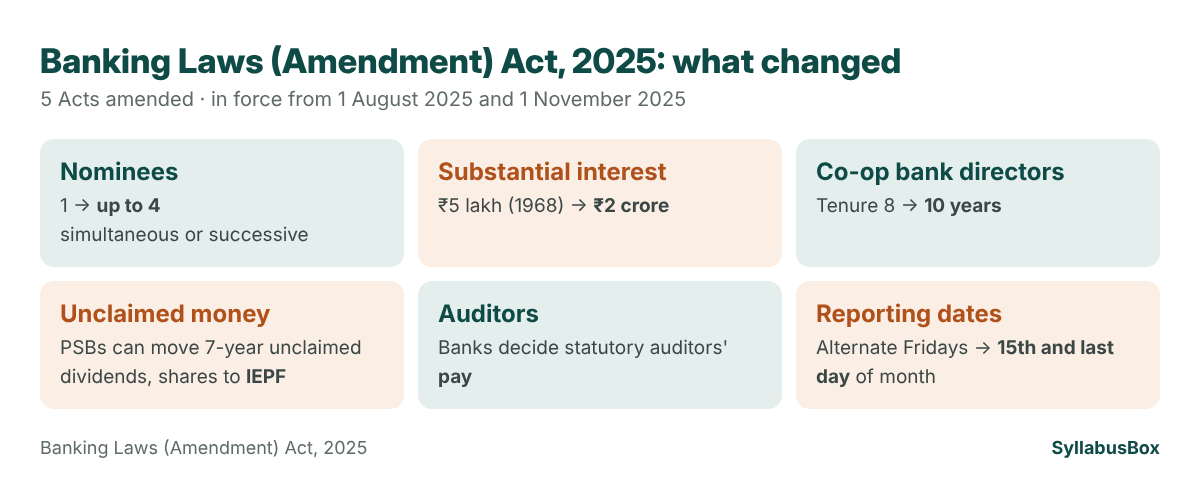
1. Up to four nominees
- Deposit holders can now name up to 4 nominees (earlier only 1).
- Simultaneous nomination: all nominees share the money in the proportion you specify (for deposits).
- Successive nomination: nominee 2 gets the money only if nominee 1 is not alive, and so on. For safe deposit lockers and articles in safe custody, only successive nomination is allowed.
- This part came into force on 1 November 2025.
2. “Substantial interest” raised to ₹2 crore
- A person has a “substantial interest” in a company if they hold shares above a limit. The old limit was ₹5 lakh, fixed in 1968.
- It is now ₹2 crore. This matters because directors with substantial interest face restrictions on loans and governance.
3. Cooperative bank directors
- The maximum tenure of directors (other than the chairperson and whole-time director) in cooperative banks rises from 8 years to 10 years. This aligns with the 97th Constitutional Amendment (2011) on cooperatives.
- A director of a central cooperative bank can now also serve on the board of a state cooperative bank.
4. Unclaimed money to IEPF
- Public sector banks can transfer unclaimed dividends, shares, interest and bond redemption amounts (unpaid for 7 years) to the Investor Education and Protection Fund (IEPF).
- Investors can later claim it back from the IEPF.
5. Auditors’ pay
- Banks get the freedom to decide the remuneration of statutory auditors (earlier RBI, with the government, decided it).
6. Reporting dates
- Banks used to report to RBI for alternate Fridays (a “fortnight”).
- Now, reporting is for the 15th and the last day of each month. This simplifies CRR maintenance and reporting.
Why it matters
- Depositors: fewer unclaimed deposits and easier claims for families.
- Governance: an old ₹5 lakh threshold was outdated after 57 years of inflation.
- Cooperative banks: more continuity in boards.
- Banks: simpler compliance.
Exam-ready one-liners
- The Banking Laws (Amendment) Act, 2025 amended 5 Acts.
- Depositors can have up to 4 nominees: simultaneous or successive.
- Lockers allow only successive nomination.
- “Substantial interest” limit: ₹5 lakh → ₹2 crore.
- Cooperative bank director tenure: 8 → 10 years.
- Unclaimed amounts of PSBs (7 years) can go to IEPF.
- Reporting dates: 15th and last day of the month instead of alternate Fridays.
- Provisions came into force on 1 August 2025 and 1 November 2025.
Related reading
Quiz: test yourself
Loading the quiz…
Based on the Act and government notifications as reported. Check rbi.org.in and egazette.gov.in for the full text.
Get daily current affairs & job alerts freeJoin SyllabusBox for updates every day.