
In one year India rewrote both its indirect tax (GST 2.0) and its direct tax law (the Income-tax Act, 2025). Expect at least one question from each in every 2027 exam. Let us take them one by one.
Part 1: GST basics
| Point | Detail |
|---|---|
| Launched | 1 July 2017 |
| Constitutional amendment | 101st Amendment Act, 2016 |
| Key articles | 246A (power to tax), 269A (inter-state GST), 279A (GST Council) |
| Type | Destination-based consumption tax |
| Components | CGST + SGST/UTGST (within a state); IGST (inter-state and imports) |
| GST Council | Chaired by the Union Finance Minister; state finance ministers are members |
| Voting | Centre one-third, states two-thirds; decisions need three-fourths majority |
| Network | GSTN (IT backbone) |
Outside GST: petroleum crude, diesel, petrol, natural gas, aviation turbine fuel (for now), and alcohol for human consumption.
Part 2: GST 2.0
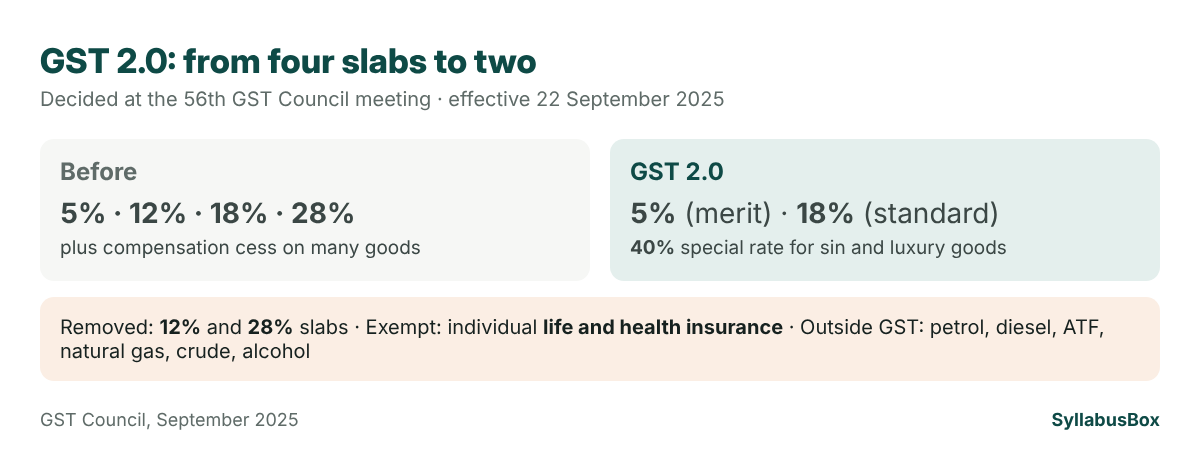
| Point | Detail |
|---|---|
| Decided at | 56th GST Council meeting, 3 September 2025 |
| Effective | 22 September 2025 (first day of Navratri) |
| Old slabs | 5%, 12%, 18%, 28% (+ compensation cess) |
| New main slabs | 5% (“merit”) and 18% (“standard”) |
| Special rate | 40% for sin and luxury goods (tobacco, pan masala, aerated drinks, large cars, etc.) |
| Removed | The 12% and 28% slabs; compensation cess phased out (approx) |
| Big relief items | Individual life and health insurance exempt; many daily items, medicines, small cars and two-wheelers, ACs and TVs moved to lower rates |
Why it matters for the economy:
- Lower prices on mass-consumption goods → more demand.
- Simpler two-slab structure → fewer classification disputes.
- Short-term revenue loss for the Centre and states (approx), expected to be offset by higher consumption.
Part 3: Income-tax Act, 2025
| Point | Detail |
|---|---|
| Replaces | Income-tax Act, 1961 |
| Got President’s assent | August 2025 |
| Effective | 1 April 2026 |
| Sections | 536 (down from about 819 in the 1961 Act) |
| Forms | About 190 (down from about 390) |
| Big idea | “Tax year” replaces “previous year” and “assessment year” |
What did NOT change: tax rates, the two tax regimes and most definitions. The Act mainly simplifies language and structure.
Other changes:
- MAT (for companies) and AMT (for non-corporates) placed in separate sub-sections.
- Virtual digital assets included in “undisclosed income” in search cases.
- Tax officers can access a virtual digital space (email, cloud, online trading accounts) during search.
- More faceless processes.
Part 4: The new tax regime (Budget 2025-26 rates)
| Income (₹) | Tax rate |
|---|---|
| Up to 4 lakh | Nil |
| 4–8 lakh | 5% |
| 8–12 lakh | 10% |
| 12–16 lakh | 15% |
| 16–20 lakh | 20% |
| 20–24 lakh | 25% |
| Above 24 lakh | 30% |
- Rebate under the new regime: no tax up to ₹12 lakh of income (₹12.75 lakh for salaried people with the ₹75,000 standard deduction).
- The new regime is the default; taxpayers can opt for the old regime.
Direct vs indirect tax: quick revision
| Point | Direct tax | Indirect tax |
|---|---|---|
| Who bears it | The person who pays it | Passed on to the consumer |
| Examples | Income tax, corporate tax | GST, customs duty |
| Nature | Usually progressive | Usually regressive |
| Administered by | CBDT | CBIC |
Exam-ready one-liners
- GST was launched on 1 July 2017 through the 101st Amendment.
- Article 279A provides for the GST Council, chaired by the Union Finance Minister.
- GST 2.0 (from 22 September 2025): main slabs 5% and 18%, plus 40% for sin goods.
- The 12% and 28% slabs were removed.
- The Income-tax Act, 2025 came into force on 1 April 2026 with 536 sections.
- “Tax year” replaced “previous year” and “assessment year”.
- No income tax up to ₹12 lakh under the new regime (₹12.75 lakh for salaried).
Related reading
Quiz: test yourself
Loading the quiz…
Based on GST Council decisions, the Income-tax Act, 2025 and Budget 2025-26 as reported. Rates on specific items change; check cbic.gov.in and incometax.gov.in.
Get daily current affairs & job alerts freeJoin SyllabusBox for updates every day.