“Why does RBI raise rates when prices go up?” If you can explain this in 150 words with the right dates, you have one ESI answer ready. Inflation targeting is one of the most asked topics in RBI Grade B, both in GA and in Phase 2. Let us build it from the start.
What is inflation targeting?
Inflation targeting means the central bank announces a numerical inflation target and uses its policy rate to keep inflation near that target. India follows flexible inflation targeting (FIT): the main goal is price stability, but RBI also keeps growth in mind.
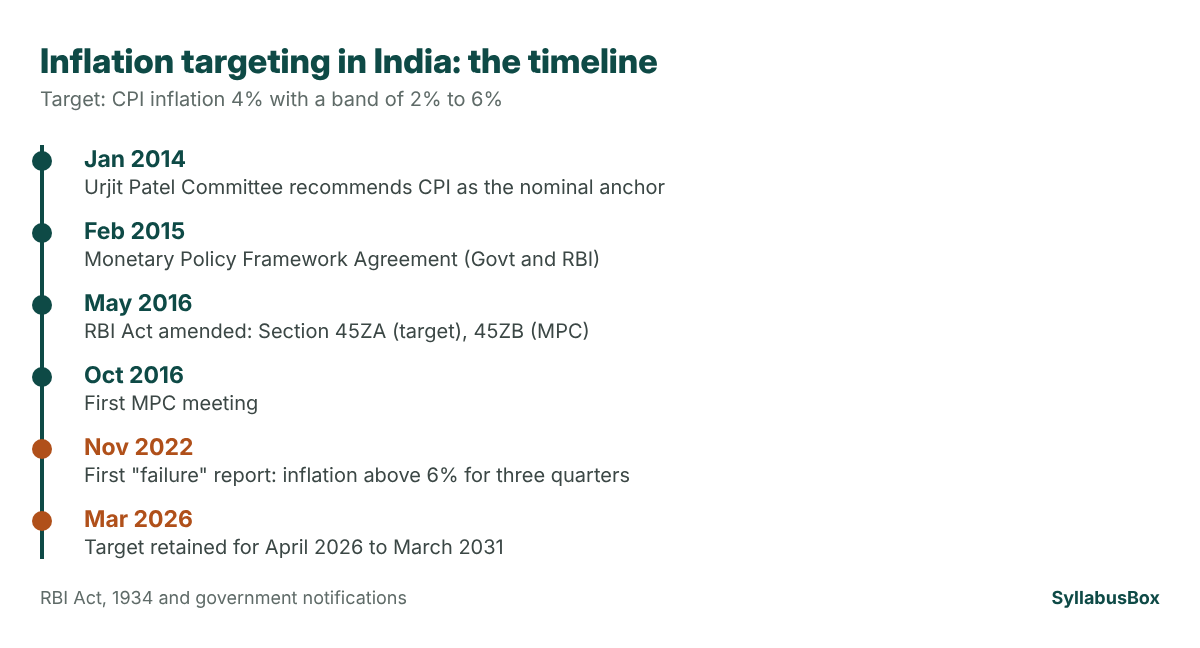
The timeline
| Year | Event |
|---|---|
| January 2014 | Urjit Patel Committee recommends CPI as the nominal anchor and a target of 4% ± 2% |
| February 2015 | Monetary Policy Framework Agreement signed between the Government and RBI |
| May 2016 | RBI Act, 1934 amended (through the Finance Act, 2016): Section 45ZA (target) and 45ZB (MPC) |
| August 2016 | Government notifies the target: 4% CPI, band 2%–6%, for 5 years |
| October 2016 | First MPC meeting |
| March 2021 | Same target retained for April 2021–March 2026 |
| November 2022 | RBI sends its first “failure” report to the government (inflation above 6% for three quarters in 2022) |
| March 2026 | Target retained for 1 April 2026–31 March 2031 |
How the framework works
| Element | Detail |
|---|---|
| Who sets the target | Central Government, in consultation with RBI, every 5 years |
| Measure | CPI (Combined): headline inflation, not core |
| Target | 4%, tolerance band 2% to 6% |
| Who decides the repo rate | MPC (6 members; Governor has a casting vote) |
| Failure | Average inflation outside the band for three consecutive quarters |
| If it fails | RBI sends a report: reasons, remedial actions, time to return to target |
Why CPI and not WPI?
- CPI reflects what consumers actually pay, including services.
- WPI covers only goods at the wholesale level; it has no services.
- Inflation expectations of households follow CPI.
How rate changes reduce inflation (transmission)
- RBI raises the repo rate.
- Banks’ cost of funds rises → loan rates rise (EBLR loans quickly, MCLR loans slowly).
- Borrowing and spending slow down → demand falls.
- Higher rates also attract foreign capital, which supports the rupee and makes imports cheaper.
- Inflation cools after a lag of about 2–4 quarters (approx).
Read more: Monetary policy transmission: MCLR and EBLR.
Has it worked?
Arguments for:
- Inflation was much lower and more stable after 2016 than in 2009–2013, when it often crossed 9–10%.
- A clear target makes RBI accountable and anchors expectations.
Arguments against:
- Supply shocks (vegetables, fuel, a war) are outside RBI’s control; raising rates hurts growth without fixing supply.
- Food has a large weight in CPI, so the target can be missed because of monsoon failures.
- Some economists want the band to be wider or the target to be core inflation.
Where we are now (November 2026)
- CPI inflation rose to about 5.5% in September 2026 (approx), mainly due to fuel and food prices after the West Asia conflict.
- The MPC raised the repo rate by 25 bps to 5.50% in October 2026.
- Inflation is still inside the band (below 6%).
Exam-ready one-liners
- Urjit Patel Committee (2014) recommended CPI as the nominal anchor.
- The Monetary Policy Framework Agreement was signed in February 2015.
- Section 45ZA of the RBI Act deals with the inflation target; Section 45ZB with the MPC.
- The target is 4% CPI with a band of 2%–6%, set every 5 years by the government.
- Failure = three consecutive quarters outside the band.
- RBI sent its first failure report in November 2022.
- The current target period is 2026–2031.
Related reading
- Monetary Policy Committee explained
- Repo, reverse repo, CRR and SLR
- ESI answers: inflation and monetary policy
Quiz: test yourself
Loading the quiz…
Based on the RBI Act, government notifications and RBI releases as reported. Latest CPI figures change monthly; check mospi.gov.in.
Get daily current affairs & job alerts freeJoin SyllabusBox for updates every day.